
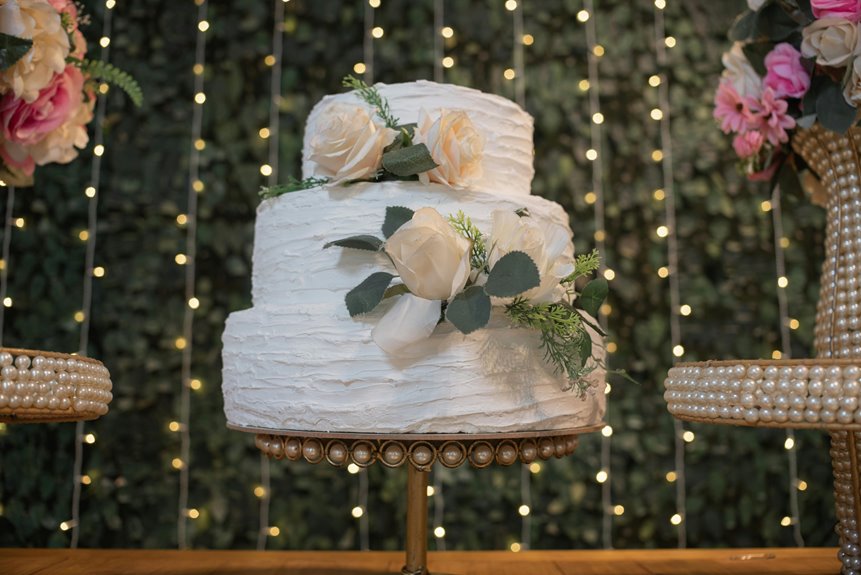
You’re looking at $500–$700 for a standard 3-tier wedding cake serving roughly 100 guests, though simpler 6-9-12 inch configurations start around $350.
Your final cost hinges on design choices—fondant and sugar flowers spike prices, while buttercream keeps things elegant yet affordable—plus delivery fees (up to $150 for distances beyond 30 miles) and add-ons like clear pillars or custom toppers.
Premium flavors and exotic fillings push costs higher, but strategic choices maintain sophistication within your budget. The key is understanding which details matter most to you.
What’s the Typical Price Range for a 3-Tier Wedding Cake?
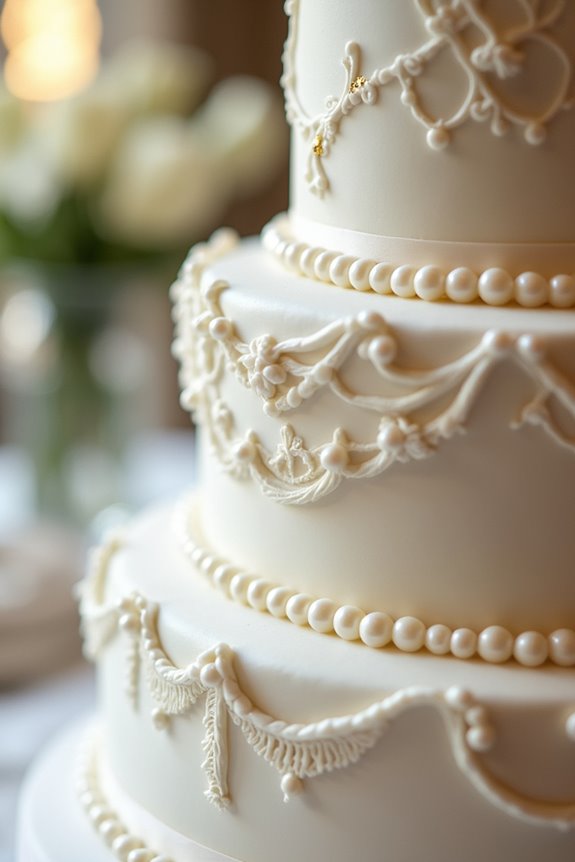
How much should you actually spend on a wedding cake? You’re looking at a price range between $350 and $700 for a 3-tier wedding cake that’ll feed roughly 100 guests. The national average hovers around $540, though your specific price range depends on several factors. A standard 6, 9, and 12-inch configuration runs $350, while enhanced flavors bump that to $375. Cottage bakeries typically charge $500–$700 for their creations. What drives these numbers? Design complexity, specialty decorations like fondant details, sugar flowers, and edible gold all add up. Don’t forget delivery and setup fees either. You’re investing in both flavor and artistry—a centerpiece that’s also delicious.
How Size and Guest Count Determine Your Cake’s Cost
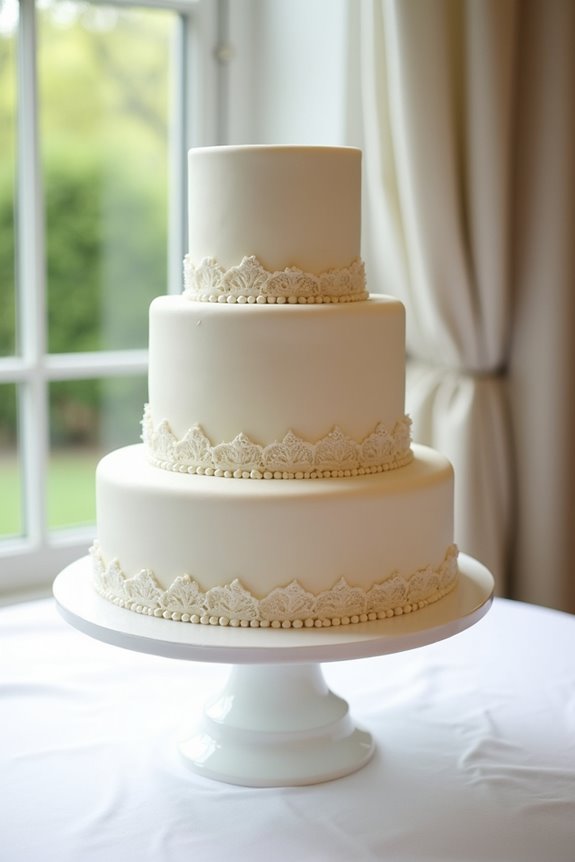
Your cake’s price tag hinges on two interconnected factors: the dimensions of each tier—a 12-inch base tier, for instance, yields roughly 40–60 servings and anchors your overall cost—and your total guest count, which determines whether you’ll need three tiers or additional sheet cakes to serve everyone. When you’re planning for 100 guests, you’re looking at substantially different pricing than a 50-person celebration; that larger headcount pushes you toward either deeper tiers or supplementary cakes, shifting your investment from a modest $350 for a standard 6/9/12-inch configuration to potentially $600 or beyond. Understanding how these dimensions interact with your attendee list—and recognizing that a bottom tier’s serving capacity directly influences total expense—helps you budget strategically while maintaining a quality centerpiece for your celebration.
Tier Dimensions And Servings
When you’re envisioning that moment—your baker wheeling out a three-tier cake as your guests lean forward in anticipation—the dimensions of each tier aren’t just aesthetic choices; they’re the scaffolding of your budget and guest experience alike. A classic 6-9-12 inch configuration yields roughly 75–120 servings, depending on slice size, while alternative arrangements like 8-10-12 inches adapt to your headcount. Your bottom tier—typically the largest—drives most servings and cost; that 12-inch base alone contributes substantial capacity. For 100 guests, you’re allocating 50–60 servings across lower tiers, reserving the delicate top tier for 10–20 slices. These tier dimensions directly influence pricing: larger servings mean higher costs, fundamentally reshaping your cake budget and enabling you to serve everyone generously.
Guest Count Budget Impact
Ever notice how wedding cake pricing shifts dramatically once you commit to a headcount? Your guest count becomes the primary cost driver—it’s the foundation determining everything else. Hosting 100 guests demands substantially larger tiers or additional support cakes than a 50-person celebration, directly impacting your budget.
Consider this: a 6″, 9″, 12″ configuration serves roughly 50–100 guests, while a smaller 6″, 8″, 12″ setup covers 40–75 servings. That size difference translates to hundreds of dollars in pricing variance. You’re not just paying for ingredients; you’re investing in structural integrity, delivery logistics, and baker expertise required for ambitious tiered constructions.
Smart couples leverage sheet cakes or cupcake towers alongside their signature 3-tier centerpiece—strategically stretching servings while controlling per-tier expenses. This hybrid approach delivers elegance without financial strain, letting your celebration succeed across your entire guest count.
What Design Details Cost the Most
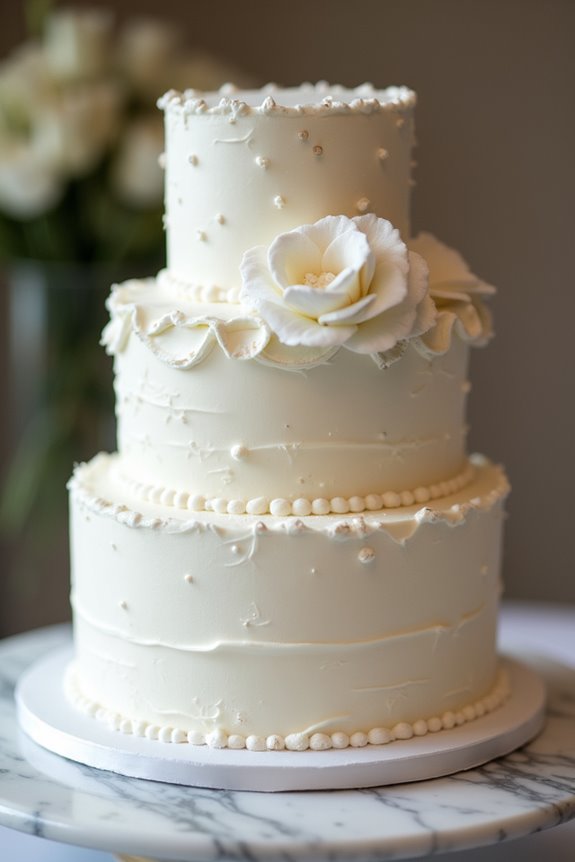
How’d you like a wedding cake that’s also delicious? When you’re planning your three-tier centerpiece, certain design elements will notably impact your budget. Fondant covers demand labor-intensive smoothing and shaping, raising costs considerably compared to buttercream. Sugar flowers and intricate piping work add $100–$500+ to your total. Specialty touches—monograms, lacework, custom toppers, and edible gold leaf—contribute substantially more than basic tiered shapes alone.
| Design Element | Cost Impact | Effort Level |
|---|---|---|
| Buttercream | Budget-friendly | Moderate |
| Fondant | Higher cost | Labor-intensive |
| Sugar flowers | $100–$500+ | Specialized |
You’re investing in artistry when you choose elaborate decorations, adding visual interest and sophistication to your cake.
Premium Flavors and Specialty Fillings: Pricing Explained
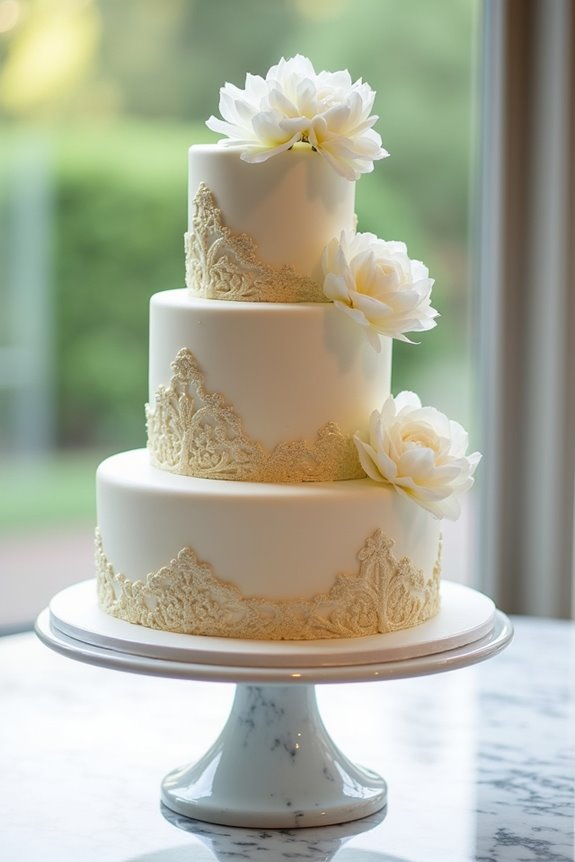
When you choose exotic flavors like lavender-earl grey or passion fruit-cardamom for your three-tier cake, you’re investing in premium ingredients that don’t come cheap—think Madagascar vanilla beans, imported Belgian chocolate, or fresh passion fruit pulp sourced at peak season. Your custom filling choices—whether that’s salted caramel with fleur de sel, stabilized Swiss meringue buttercream infused with champagne, or layers of house-made lemon curd—each carry distinct price tags that reflect both ingredient quality and the baker’s technical expertise. These flavor and filling upgrades can easily shift your cake from a $400 base price toward $600–$800 or beyond, especially when combined with intricate piping or hand-crafted sugar flowers that complement those sophisticated tastes.
Exotic Flavor Cost Breakdown
Why choose basic flavors when you can have champagne-infused sponge layered with French pastry cream and fresh raspberries—or perhaps Earl Grey cake with lavender buttercream and white chocolate ganache?
Your exotic flavor choices will increase your cake’s final price substantially. These premium flavors and custom elements add costs to a standard three-tier cake, pushing expenses well beyond the $300–$800 base range.
| Flavor Profile | Filling Type | Price Addition |
|---|---|---|
| Champagne & Raspberry | French Pastry Cream | $150–$250 |
| Earl Grey & Lavender | White Chocolate Ganache | $200–$350 |
| Passion Fruit & Yuzu | Luxury Mascarpone | $250–$400 |
Fresh fruit, artisanal ingredients, and unique pairings add $100–$500 depending on availability and complexity. Your location and bakery reputation further influence these premiums, with high-demand areas commanding steeper pricing for these sophisticated selections.
Premium Ingredient Investment
If you’ve decided that champagne-infused sponge and French pastry cream deserve a spot at your celebration, you’re already thinking like a baker—and you’re also committing to a significant investment beyond that $300–$800 base price. Premium ingredients like Madagascar vanilla, imported Belgian chocolate, and specialty fillings—think lavender-honey or earl grey mascarpone—create a cost increase of roughly $100–$500+, depending on sourcing complexity. You’re not just paying for ingredients; you’re investing in craftsmanship, quality, and the distinct taste that separates well-executed from ordinary. Each premium element—exotic fruit curd, hand-churned buttercream infused with real champagne, edible gold leaf accents—adds layers of sophistication that people will notice and retain in memory, making your cake a direct reflection of your celebration’s standard.
Custom Filling Price Variations
How significantly does switching from basic vanilla buttercream to something like passion fruit curd or black currant mascarpone reshape your cake’s final bill? Custom fillings personalize your 3-tier cake—and that customization carries real cost factors you’ll want to understand.
When you venture beyond standard flavors, here’s what shifts your pricing:
- Artisan fruit curds ($40–$75 per tier) demand premium fruit sourcing
- Mascarpone and cream cheese bases ($35–$60 per tier) require quality dairy
- Ganache variations with single-origin chocolate ($50–$80 per tier) add sophistication
- Infused syrups and liqueurs ($25–$45 per tier) add complexity
Each tier’s custom filling compounds your investment. That passion fruit option you’re considering? It’ll likely push your total toward the $500–$700 range—a meaningful jump from simpler designs, but worth the investment.
Delivery, Setup, and Add-On Fees to Expect
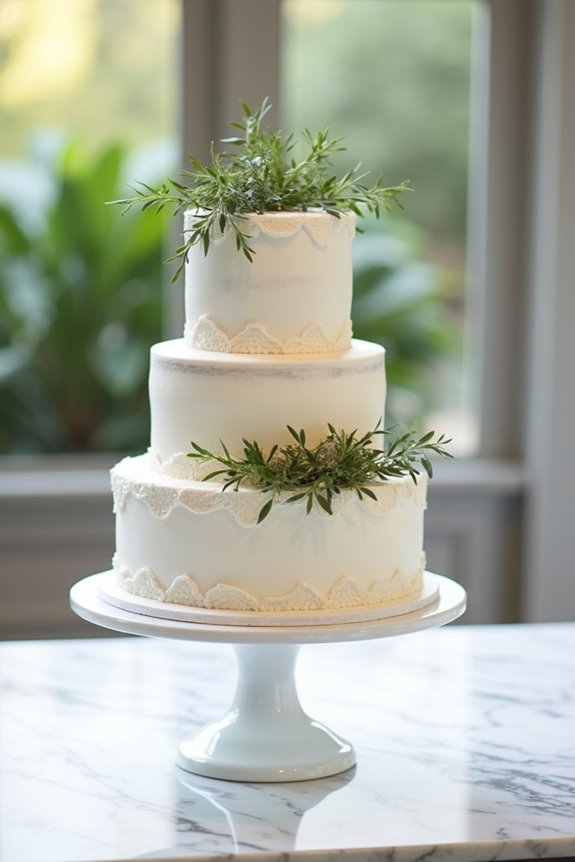
Beyond the cake itself, you’ll encounter a cascade of fees that’ll shape your final invoice—delivery charges that climb with distance, setup services, and those enticing structural upgrades that elevate a simple three-tier cake into an architectural centerpiece. Your cake designers calculate delivery costs based on location: pickup runs $15, New Glarus Downtown adds $25, while distances up to 30 miles can reach $150. Setup’s included, but cupcake display rental costs $30 extra. Want your tiers polished? Clear pillars ($25) and direct layering ($15 per tier) add visual impact. These add-ons accumulate quickly, yet they’re what distinguish a standard cake from a refined centerpiece. Budget accordingly—your cake’s price tag extends beyond the frosting and fondant.
Save Without Sacrificing Quality: Budget-Friendly Design Choices
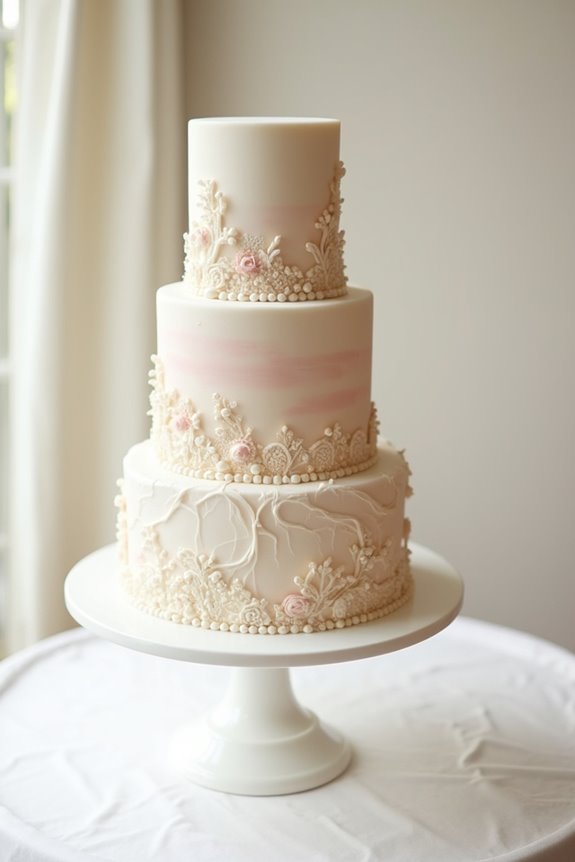
While those add-on fees can quickly inflate your final bill, you have real power in shaping an elegant cake that won’t drain your budget—and it starts with embracing simplicity as sophistication.
Embrace simplicity as sophistication—shape an elegant cake that reflects your taste, not just your budget constraints.
Consider these refined approaches:
- Buttercream elegance — smooth, understated finishes cost significantly less than fondant or hand-spun sugar work
- Monochrome palettes — single-color schemes with subtle piping create refined impact without elaborate decoration fees
- Standard flavors — vanilla, chocolate, or lemon showcase quality ingredients without premium pricing
- Strategic supplementation — pairing your 3-tier centerpiece with sheet cakes reduces per-slice costs while maintaining visual drama
You’ll land comfortably in that $500–$700 range, even accounting for delivery fee expenses. The result? A sophisticated cake that reflects your taste and values—not just your budget constraints.